
Kane County Scheduled Versus Actual Release
Utah does not advertise one universal “projected release date” field. The UDC public-information list uses Parole/Expiration Date, while its release-day material uses parole or release date. A parole date authorizes conditional release under the operative Board order and approved plan. An expiration date relates to the lawful end of a sentence. A termination order may end supervision earlier when authorized. Those terms describe different events.
An actual release is the completed movement shown by the releasing agency. A Board order can grant a future parole date, yet later conduct, a new case, a rescission order, an unapproved plan, or a detainer can stop or reroute the event. County jail processing also may not occur at the moment suggested by a raw sentence calculation. The final Kane County record must show what happened and whether the person returned to the community or moved to another authority.
Kane County Release Dates by Custody
The first check is jurisdiction. Kane County Jail holds local and state defendants before trial and can house people serving definite county terms. A person committed to Utah state prison falls under UDC and the Board even if temporarily housed in a county jail. Federal and immigration custody use separate records. Mixing the systems is the main cause of false date estimates.
| Custody situation | Date source | Key limit |
|---|---|---|
| Pretrial at Kane County Jail | Court order, bail record, pretrial decision, jail movement entry | No fixed release date exists while the case and custody ruling remain open |
| Definite Kane jail sentence | Judgment, credited time, jail’s computed release record | No local published good-time or weekend formula was found |
| Utah state-prison sentence | Latest Board order plus UDC parole/expiration information | Utah’s indeterminate framework is not simple sentence arithmetic |
| UDC prisoner in a county bed | UDC and Board records | Placement in a county facility does not turn it into a county sentence |
| Transfer or detainer | Movement record plus receiving authority | Departure from one jail is continued custody, not community release |
The Kane County released-inmate hub explains how to pair each departure with the right receiving system in the Kane County release search.
Note: A pretrial detainee has no set Kane County release date until legal authority permits departure.
Find a Kane County Projected Release
For a Utah prison sentence, start with the Board Hearings and Decisions search. Search by first and last name or UDC offender number. Open the latest published decision, not just a scheduled-hearing row. Then check the UDC Offender Search for current legal status and available parole or expiration information. UDC’s public tool covers only people currently under its supervision, so a fully discharged person may no longer appear.
For a Kane County Jail sentence, obtain the judgment and minute entries from the correct court. Identify the definite term, any time-served credit, and whether counts run together or one after another. Then call Kane County Jail and request its computed date or movement information. When dated proof matters, use the sheriff GRAMA channel for the existing release entry.
- Get the judgment and identify county jail, Utah prison, or another custody system.
- List each count, the sentence structure, credited confinement, and any stated minimum.
- For state prison, search the Board and read the newest order in full.
- Check UDC status and any parole or expiration date shown for the same offender number.
- Look for later rescission, redetermination, violation, or amended court action.
- Near the date, verify processing with UDC or Kane County Jail and obtain the completed movement record.
A same-name match is not enough. Compare the UDC number, court, case, sentence, and order history before treating the date as tied to the correct person.
Utah Rules for Kane Release Dates
Utah Code section 77-18-111 generally makes a state-prison sentence indeterminate. The judgment states a lawful minimum-to-maximum range rather than a definite prison release day. The sentence continues to the maximum unless the Board sooner terminates or commutes it. The Board evaluates the total sentence, including concurrent and consecutive terms, and schedules an original hearing under state law and its guidelines.
Section 77-27-9 permits parole within the Board’s authority but generally bars release before the minimum term has been served. Early action requires the statutory findings and a noticed, open, recorded hearing. Some offenses carry mandatory minimums or no-parole restrictions. The judgment, offense statute, and latest Board order therefore control the case-specific answer.
- Indeterminate sentence
- A prison range whose release point is governed by law and Board action, not a fixed day set by the trial court.
- Concurrent terms
- Sentences that run at the same time, subject to the judgment and Board calculation.
- Consecutive terms
- Sentences structured to run one after another and combined into the total sentence.
- Rescission
- Board action that can withdraw a previously granted future parole date.
Kane County Good-Time Date Limits
No official source reviewed supports a universal Utah rule that every state prisoner serves 85 percent of a sentence. That shorthand should not be imported from the federal system or another state. Utah’s ordinary state-prison framework is indeterminate. A public researcher cannot turn the range into a guaranteed date by subtracting a standard credit.
Programs, credited confinement, sentence structure, Board guidelines, conduct, and an approved release plan can affect scheduling or Board action. They do not replace the current order. For a county-jail misdemeanor sentence, the court generally imposes a definite term. Confirm time-served credit in the judgment and ask Kane County Jail for the computed record. No Kane County-published good-time schedule, “two-for-one” formula, weekend-release rule, or fixed release hour was found.
Why Kane County Release Dates Change
A projected date is sensitive to later legal and administrative events. The strongest check is chronological: start with the sentence, follow every Board order, then compare the live UDC status close to the date. For a county term, add the jail’s own computation and movement entry.
| Factor | Possible effect | Record to check |
|---|---|---|
| Credited confinement | Changes the amount of a definite jail term still to serve | Judgment and minute entries |
| Concurrent or consecutive counts | Changes the total sentence structure | Judgment and Board sentence calculation |
| Board grant, denial, or review | Creates, rejects, or postpones a parole date | Latest Board decision |
| Rescission or violation | Can remove an earlier date or return a parolee to custody | Later Board order and UDC status |
| Detainer or warrant | Can cause transfer to another authority instead of community release | Jail movement record and receiving locator |
| Release plan or placement | Can affect implementation or route release to a community correctional center | Board order and UDC confirmation |
These events also explain why a VINE notice, old docket entry, or hearing date should not stand alone. Each shows one part of the person-specific release timeline.
Note: A Kane County jail transfer date and a state-prison parole date can be separate events.
Kane County Board Date Evidence
The Board search holds more than one kind of event. An original hearing considers possible release for a parole-eligible prisoner. A redetermination can revisit a long-range decision under the Board’s criteria. A rescission hearing can follow new conduct, a conviction, or another issue after a future date was granted. Paper review can resolve information without a full hearing, while special attention may correct an error or address an exceptional written request.
A published decision can grant parole, order expiration, set another review, change conditions, revoke parole, or rescind an earlier date. “Deferred” and “review” are not release outcomes. Preserve the order date and link, then search for entries issued later. If the online record cannot be accessed, the Board lists 801-261-6464 for help and provides a GRAMA request form. Ask for the final order plus any later modification, rescission, or termination order.
Near the planned date, check UDC legal status again. The Board order establishes authority, but UDC processing confirms whether the person left prison, entered parole, moved to a community correctional center, transferred to another authority, or remained in custody. Those results have different meanings for a Kane County projected release date.
Tuesday Utah Releases Affect Kane Cases
UDC’s Release Day guidance says most Utah prison paroles and releases are processed on Tuesdays at Utah State Correctional Facility. The rule applies even to almost all UDC prisoners temporarily housed in county jails. Direct release from a county jail on a UDC sentence is described as extremely rare, with family notified if it applies.
This is a state-prison practice. It is not Kane County Jail’s schedule. A person may leave a Kane-area county bed to reach UDC processing without having entered the community. At USCF, UDC transports people paroling to a Community Correctional Center to that structured placement. It also describes case-specific help to a nearby TRAX station for people without rides. No matching Kane jail transport policy was found.
The official UDC release-day page shows the system that controls those Utah prison logistics.
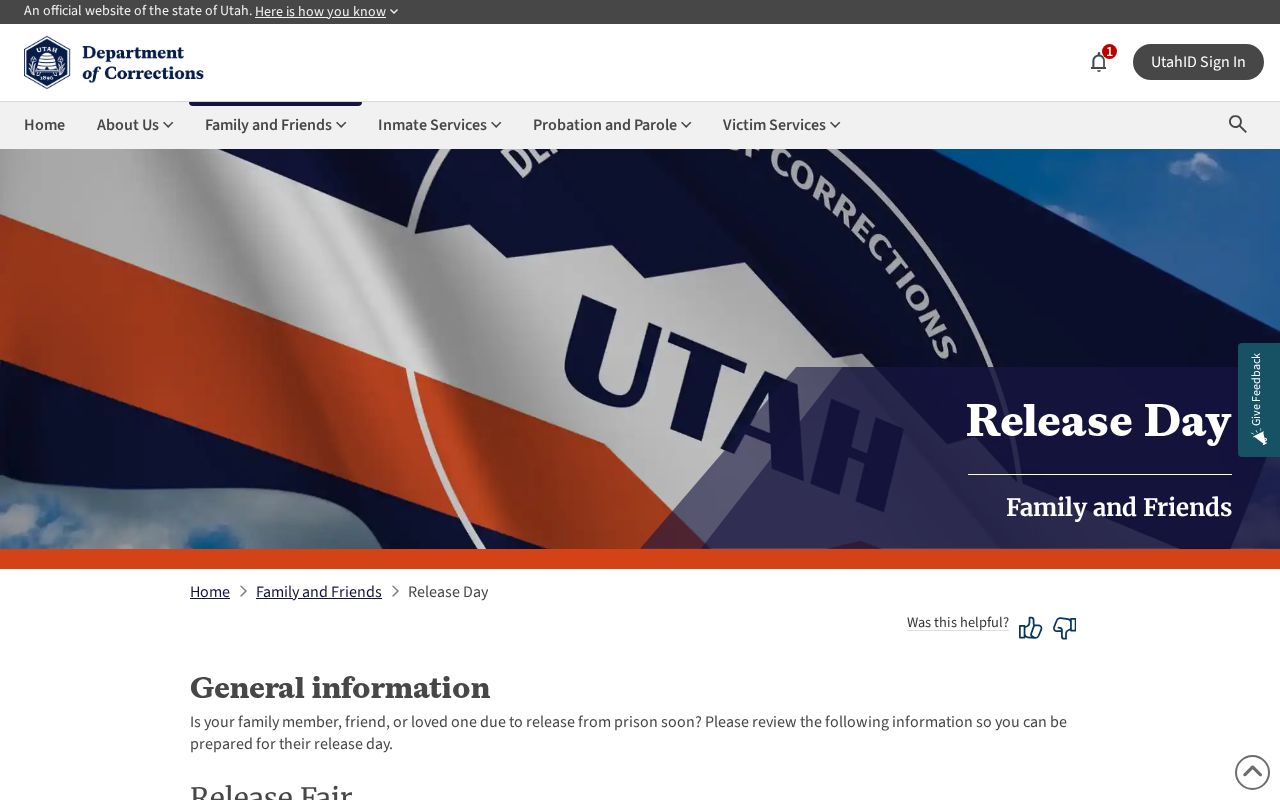
The Tuesday process must be linked to a UDC sentence and current person-specific confirmation, not applied to a Kane County Jail term.
Confirm Kane County Actual Release Dates
Close to a state-prison date, compare the newest Board order with UDC status and release-day instructions. A Utah VINE alert can help track a pending change. Register only on the matching person’s record and read the event label carefully because transfer, movement, and release are not the same. The Kane County VINELink check explains the one-person search and alert process.
After the event, seek the issuing record. For Kane County Jail, request the booking/release or custody-movement entry with the release date, time, type, authority, and destination where maintained. For UDC, request the release, termination, or expiration record when the public search no longer shows a fully discharged person. A Board order supports the authority, while the custody record proves execution.
A negative search result never supplies a release date. State only that the person was not found in that system at that time, then use the court, Board, jail, or records-request fallback appropriate to the custody type.